The School Outlived The Businesses By Forty Years
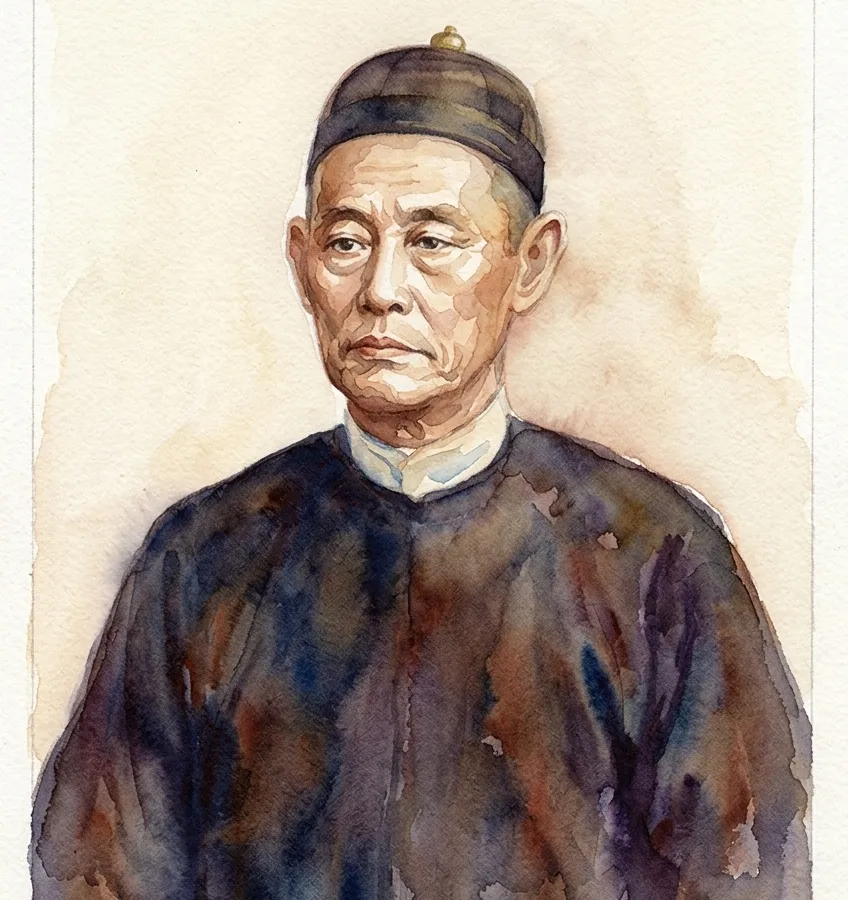
He paid for the school, then did the harder thing — he wrote down who would run it and where the money would come from after he was dead. His company died with him in three years. The school ran forty.
I knew Gan Eng Seng as a school long before I knew it was a man.
The man had almost no schooling himself. Enough to read simple English and keep accounts. That was all of it.
Here's what I didn't know until recently:
He was born in Malacca in 1844, eldest of five in a poor Hokkien family. His father died when he was 16. He crossed to Singapore, and the only work going was nutmeg — plantation labour, and selling on a very small scale.
In 1861 Guthrie & Co. took him on as an apprentice. He kept the books at their godown on Collyer Quay. Assistant storekeeper. Then chief storekeeper. Then chief compradore, in 1874. He held that last post for 25 years, until the day he died.
Thomas Scott, a Guthrie partner, backed his side ventures. The one that mattered supplied Chinese labour and bullock-cart transport to the Tanjong Pagar Dock Company. That built the fortune. He ended up a co-founder of Ee Hoe Hean, a club of Chinese millionaires.
Then in 1885, at 41, he opened a school.
Free. For poor boys. English and Chinese together — the Chinese being Hokkien, the language the boys actually spoke.
In 1889 the government offered a site on Telok Ayer Street.
He paid for the building himself. S$5,000. Two storeys, room for 300 boys.
On 4 April 1893 the Governor, Sir Cecil Clementi Smith, opened it: "I know of no similar institution in the colony."
On 9 September 1899, at 3.30 in the morning, at his house on Amoy Street, he died of blood poisoning. The obituary gives the cause as "a prick on the thumb from a piece of iron." He was 55.
His business passed to his son. It lasted about three years.
The school lasted forty.
Before he died he wrote it into his will. Money for maintenance. A board of trustees to run it.
Tan Keong Saik. Lee Cheng Yan. Song Ong Siang. Lim Boon Keng. Some of the biggest names in Singapore, plus his own descendants, running one man's free school for poor boys, self-funded, for close to four decades after he was buried.
Then the 1930s. The Depression dried up the community money. The wooden building took dry rot and termites.
In 1937 the board wrote to the Education Department, set out the school's plight, and asked the government to take it over.
In 1938 it became a government school.
Here's what stays with me:
Anyone with money can pay for a building.
He paid S$5,000 for his, and that was the easy half.
The hard half is writing down who runs it after you, and where the money comes from. He did both.
We celebrate the opening ceremony. What decides whether the thing still exists in 1937 is the maintenance line and the list of names.
On 3 January 2025, 1,208 students, staff and alumni stood in the school square and formed the number 140.
Most of them know it as a school.
If you stopped showing up tomorrow, who is written down as the person who keeps it running?
This is the LinkedIn edit — written to fit inside 3,000 characters.