Singapore Named A Library After Him. I Couldn't Have Told You Why.
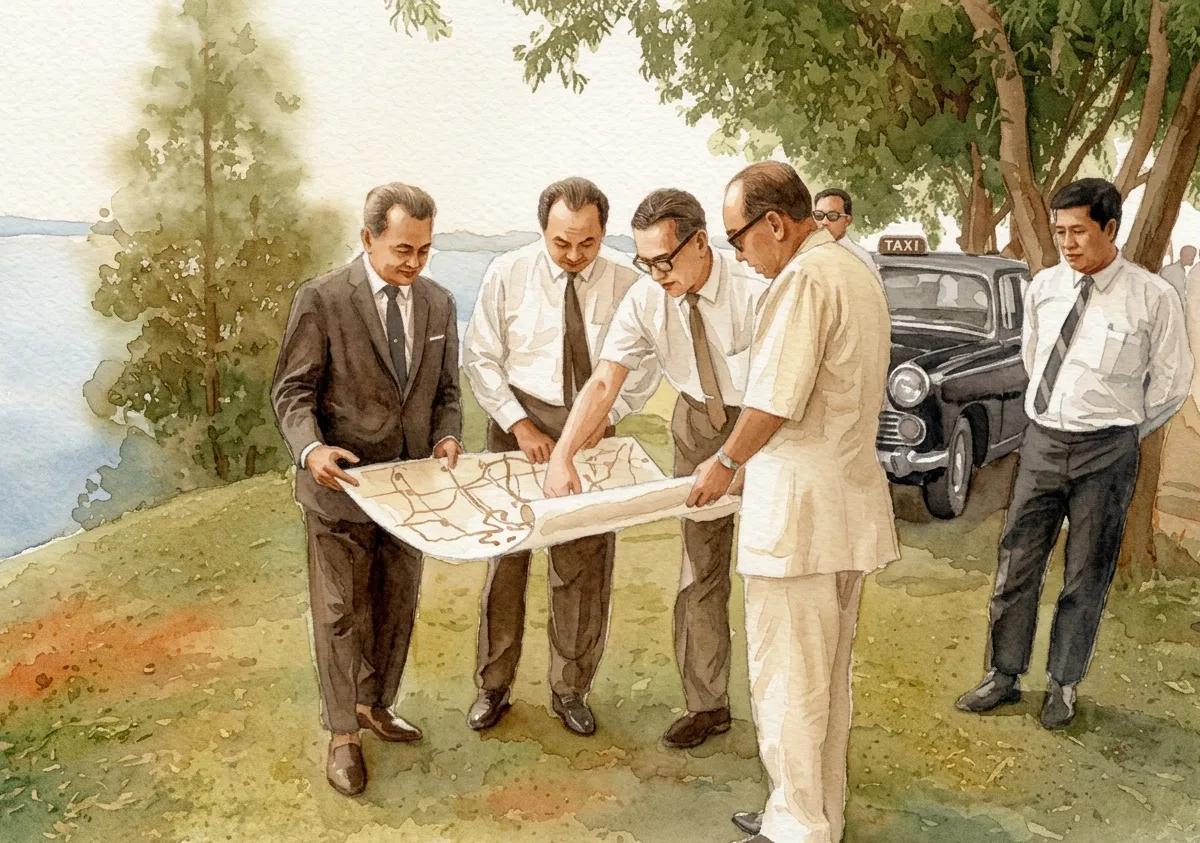
He ran the agency that filled Jurong, and by his own account twenty years later it made a policy of giving the limelight to the projects rather than itself — which is why the estate is famous and the man is a library and a road.
Singapore has a Hon Sui Sen Memorial Library and a Hon Sui Sen Drive. I couldn't have told you what the man did.
Here's what I didn't know until recently:
He ran EDB, the agency that filled Jurong. And EDB, by his own account later, made a policy of giving the limelight away.
He said it at EDB's twentieth anniversary dinner in 1981. The board, he said, "has sought not to publicise itself but rather to give the limelight to the projects it has brought to Singapore."
Jurong in 1961 was swampland, forested hills, prawn ponds, farms and plantations. Clearance began that September. The hills came down. The earth filled the swamp.
By the end of 1963 the earthworks had moved 1.8 million cubic metres of earth. 1,800 acres lay ready for industry. Two factories were in production.
Between them, they employed 90 workers.
Ninety.
Goh Keng Swee, the finance minister, called the earthworks a "mountain of labour". Critics called the place Goh's Folly.
Local money stayed away. EDB was courting makers of fertiliser, plywood, acid, animal feed, joss sticks and wigs. A salted-egg manufacturer from Hong Kong showed interest. EDB rolled out VIP treatment.
That's what open for business looked like.
So Goh ordered a blitz. One factory opening ceremony every day, for three months. Ninety of them. There weren't even nine factories open.
The job landed on a young EDB assistant named Chan Chin Bock. He and his colleagues found the way through. One event when an investor signed. Another when construction began. A third when production started.
Ninety days of news out of an almost-empty swamp.
The projects got the coverage. The minister got the podium. The board that arranged it took no bow.
Hon's own moves look nothing like headlines.
He plotted the estate's layout alongside a chief engineer and an Australian surveyor. Two Indonesian businessmen wanted their steel mill in Tanglin Halt. One of them, Tan I Tong, remembered what Hon told him: "Mr Tan, you want your permanent residence? Then don't start your mill in Tanglin Halt, start it in Jurong."
He offered no grant. That mill became NatSteel.
By 1969, the year after Hon left EDB, Jurong had 181 factories in production. More than 20,000 people worked in them.
Hon was Finance Minister from 1970 to 1983. Lee Kuan Yew, on those years: "In his unassuming way, he never claimed any credit for it."
Here's what stays with me:
Credit and leverage are different currencies. Most of us only know how to spend one.
Hon paid in credit. A residence permit was the only leverage he had. He spent it.
The man who never took the credit ended up as a library at NUS. A room inside it holds his medals and his personal seal.
What are you holding onto for the credit, when trading it away would buy you the thing you actually need?
This is the LinkedIn edit — written to fit inside 3,000 characters.