Ketchup
Every diner table in America carries a Hokkien word from the Straits of Malacca. Nobody knows it.
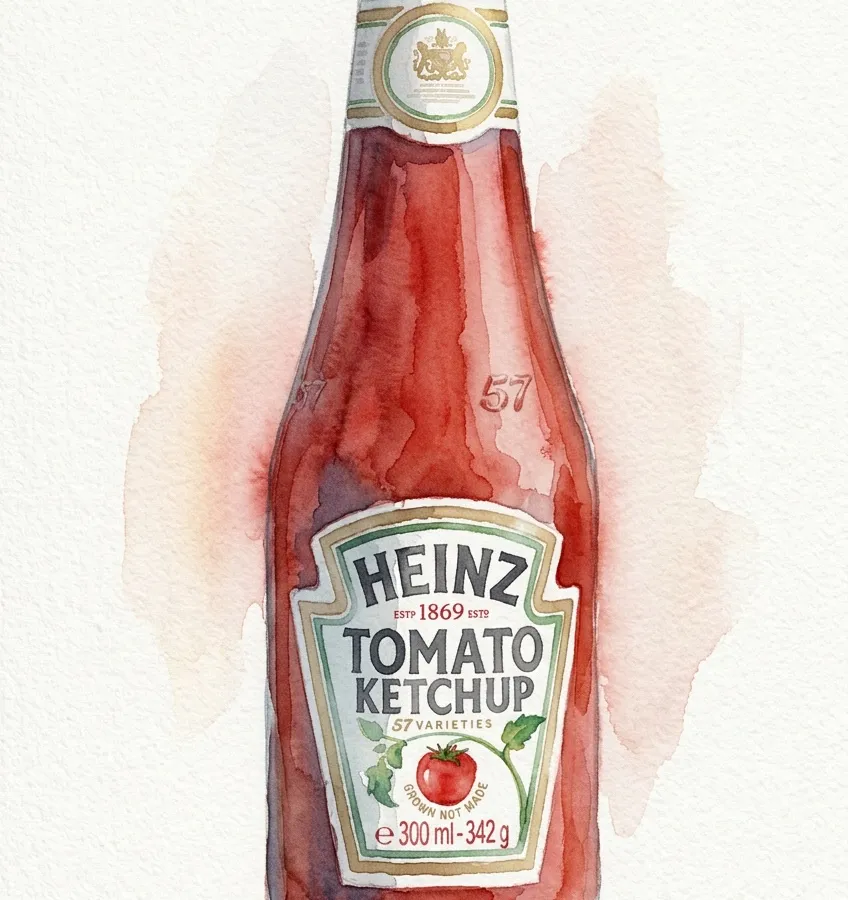
Every American diner I've ever been to has a bottle of Heinz on the table. Red cap, glass bottle, the whole ritual of slapping the base to get it out. Ketchup. As American as apple pie.
Here's what I didn't know until recently:
The word "ketchup" is Hokkien.
Ke-tsiap. Preserved fish sauce. Ke means preserved fish, tsiap means sauce. From Fujian province, the same Hokkien dialect spoken across Singapore, Penang, and Malacca for centuries.
But the original product was nothing like what's on that diner table. It was thin, dark, pungent. Anchovies layered in jars with cooked rice and salt, covered with bamboo leaves, left to ferment. Hokkien traders carried it across every port in Southeast Asia. By the time the Straits of Malacca became the busiest trade route in the world, ke-tsiap was everywhere.
Then the British showed up.
East India Company merchants tasted it in the 1600s and lost their minds. By the 1690s, English dictionaries defined "ketchup" as "a high East-India sauce." They brought the word home. Tried to recreate it.
Here's where it gets interesting.
For 200 years, nobody put tomatoes in ketchup. The English made mushroom ketchup. Walnut ketchup was Jane Austen's favourite. There was an oyster version that called for 100 oysters and three pints of white wine. Plum ketchup. Celery ketchup. All fermented, all pungent, all trying to copy that Hokkien original.
It wasn't until 1812 that an American doctor published the first tomato ketchup recipe, calling tomatoes "love apples." By the 1890s, commercial brands were cutting corners so badly that most ketchup was dyed red with coal tar.
Then Heinz cleaned it up. Went preservative-free. Made it a staple. Today, 650 million Heinz bottles a year. 97% of American households. A $19 billion global market.
But here's the thing that stays with me:
Go to Indonesia today and order kecap. You'll get soy sauce. The word never changed meaning in Southeast Asia. It still means fermented sauce, the way it always did. Only in the West did it mutate from salted fish to sugared tomatoes, from a Hokkien trader's cargo to a plastic packet at McDonald's.
Every Heinz bottle carries a Hokkien word from the Straits of Malacca. The Americans just forgot where it came from.
What's a word you use every day that turned out to have a completely unexpected origin?
This is the LinkedIn edit — written to fit inside 3,000 characters.