The soy sauce that takes nine months
There is a bottle of soy sauce in your kitchen door. It cost about three dollars.
There's another one, made in Jurong. It costs $36.90.
Same beans. Same salt. Same water.
The difference is time.
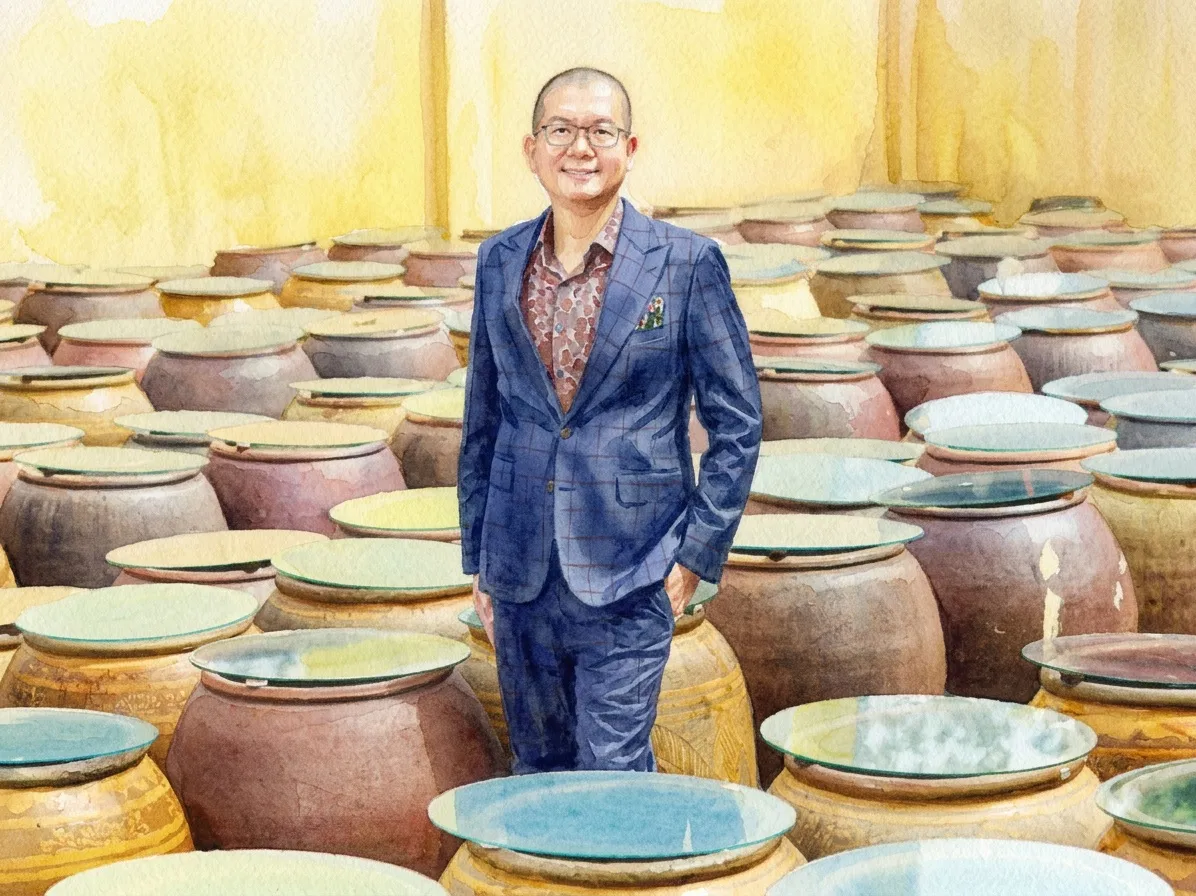
At the Nanyang Sauce brewery: a few hundred clay vats. A hundred litres each. They sit under the sun.
Soybeans go in with salt and water.
Then nothing happens, slowly, for most of a year.
Industrial soy sauce doesn't work like that. It's made with hydrochloric acid. A day. Two weeks at the outside.
Forty times faster.
Here's what I didn't know until recently:
Those nine months nearly killed the family that owned them.
## A packet of mould in his luggage
Tan Tiong How arrived from Fujian in 1942.
He brought two things. His grandmother's recipe. And a packet of aspergillus.
Koji. The mould that changes a soybean.
He wasn't starting a business. He wanted his porridge to taste right.
So he brewed at home, for himself.
Other migrants tried it. They kept coming back. It tasted like home.
By 1951 he was selling door to door off a tricycle.
By 1959 he had a factory in Paya Lebar. And a brand name. Golden Swan.
He was not unusual.
Singapore had over seventy soy sauce businesses then. Some were sheds. Some were real factories.
A bottle cost fifty cents.
His daughter Tan Poh Choo remembers the runs.
"Back then, there would only be one road that led to a kampung," she says. "When you drove your lorry on it, it was like sailing on a ship."
Then the industry started dying.
The state took back their land. They moved to industrial estates. Rents went up. Kikkoman arrived in the mid-eighties. Costs climbed.
Most moved production to Malaysia. Or shut the doors.
Fewer than ten companies are left.
## Then the old man died
His grandson hung around the Paya Lebar factory.
Ken Koh sat in his grandfather's chair. Pretended to be the boss. Opened the drawer. Counted the money.
His grandfather gave him a job. Watch stock prices on Teletext.
That was the whole apprenticeship.
Ken was twelve when his grandfather died.
1996. A heart attack. No warning.
And no will.
Six children, holding a factory. Ken's mother was the eldest.
"When he left, he left a huge gap," she said. "My uncles were the workers, they were not the entrepreneurs."
She took it on anyway.
She'd been warned. Her own father told her once: "This line is very tough, it would be better if you can avoid it. The future is very uncertain."
She passed it on.
"You can make money from pen and paper," she told him. "If you got a degree, why come back and do all this kind of back breaking coolie work?"
So he didn't come back.
He took a business degree. Started a leadership training company. Ran it over a decade.
Then, around 2017, he opened the books.
## Sixty thousand a day
The company was losing money.
The sauce wasn't the problem.
"But I knew that we had good soy sauce, because long-time customers have stayed with us," he said.
The gap between cost and price was the problem.
"We were stuck," he said. "The price of the product had to stay the same, because it was the same price as the big commercial brands of soya sauce. But the cost of ingredients was going up and margins were going down."
That's the trap. In three sentences.
Nine months of land, labour, vats and sun. Priced against something made in a day.
The back office was worse.
"There was no proper accounting system, no proper inventory management system, no enterprise software," he said. "It was very much based on trust."
Fewer than ten staff, most of them in their sixties.
A regional rival made sixty thousand bottles a day.
"That's probably our production capacity for a year," Ken said.
He wasn't planning to stay.
"I originally wanted to come in and just do a quick turnaround," he said. "Make the business more profitable and then leave to do my own thing."
Then he visited a museum.
It belonged to a big regional manufacturer. The exhibits showed soy sauce made three hundred years ago. Bamboo trays. Clay vats. Sun.
Ken recognised his own factory.
"I said, this is exactly how we are making soya sauce right now," he said. "I think we got something special and worth preserving."
The history on display was his Monday.
## Nobody in the family agreed
He wanted to sell it premium. Aged. Hand-brewed. Priced like it.
The senior generation said no.
They let him try, eventually. On one condition.
Under a different brand. Separate from the family company. Somewhere it couldn't disturb anything.
The brand was called Nanyang Sauce.
An uncle put a number on it. "You cannot sell one bottle for more than $10!"
The oldest man was around seventy. He wouldn't accept the merger. He retired instead.
"It was not a happy or proud moment," Ken said. "To this day I wish he hadn't."
Here's what Ken changed about the sauce.
Nothing.
Beans still boiled in drums. Still spread on steel troughs. Still bamboo trays, flour, mould. Still four days of resting.
Still clay vats, decades old. Old vats make better sauce.
Still the sun. Still yellow to white to green.
Still nine months. Longer when the monsoon comes.
Bottling is done by hand. So are the labels.
What changed was the invoice.
The Premium Brew is $13.90. The twelve-month first draw — 头抽, the virgin brew — is $36.90.
Nearly four times his uncle's ceiling.
Then he went further.
For $8,888 you can commission your own vat. A hundred litres. Organic Bhutan beans. Himalayan pink salt. Tuned to your taste across all five.
You sign a non-disclosure agreement. Nobody else gets your sauce.
"People have done it for alcohol such as whiskey by the barrel," he said. "But this is the first time people can now buy customised soy sauce."
"It's also owning a piece of Singapore's heritage," Ken says, "because our craft is vanishing."
Which is the part everybody misses.
"Most people do not know much about soya sauce," Ken says. "We think it's a condiment and always the same: it's black, it's salty, and it has some flavour. But it is not."
"There is sweet, sour, salty, bitter and umami. You get that bean taste, you get that fragrance and it's not just salty."
The companies merged in 2019.
The business is profitable now. He won't say how much.
A few thousand orders a month. A shop.
Workshops where you brew a batch yourself. Then watch it nine months.
There's a salt, too. It forms at the bottom of the vats. Ten years or more. Tiny amounts.
He calls it the most precious salt in the world.
His mother was named a Steward of Intangible Cultural Heritage in 2021. For the craft of hand-brewing soya sauce.
He's building a brewery in Bhutan now, two thousand metres up.
His nine-year-old comes to the factory. She loves it there.
Same as he did. In the chair. Counting the money.
Here's the thing.
The nine months never changed. His grandfather did nine months. His mother did nine months.
Neither put it on the price tag.
They couldn't. Seventy breweries all took nine months. Nine months was worth nothing.
It's what soy sauce cost.
Fewer than ten left, and it's worth everything.
The sauce never changed.
The world got faster. Nobody noticed. The slow thing had become the rare thing.
"I see ourselves as craftsmen and farmers," Ken says, "rather than a factory industrialist."
Same vats his grandfather ran. He stopped apologising for them.
So go look at that bottle in your kitchen door.
Then ask what takes you nine months. And who told you it was worth three dollars.