C.K. Tang
He didn't buy the land. He bought the people who drove past it.
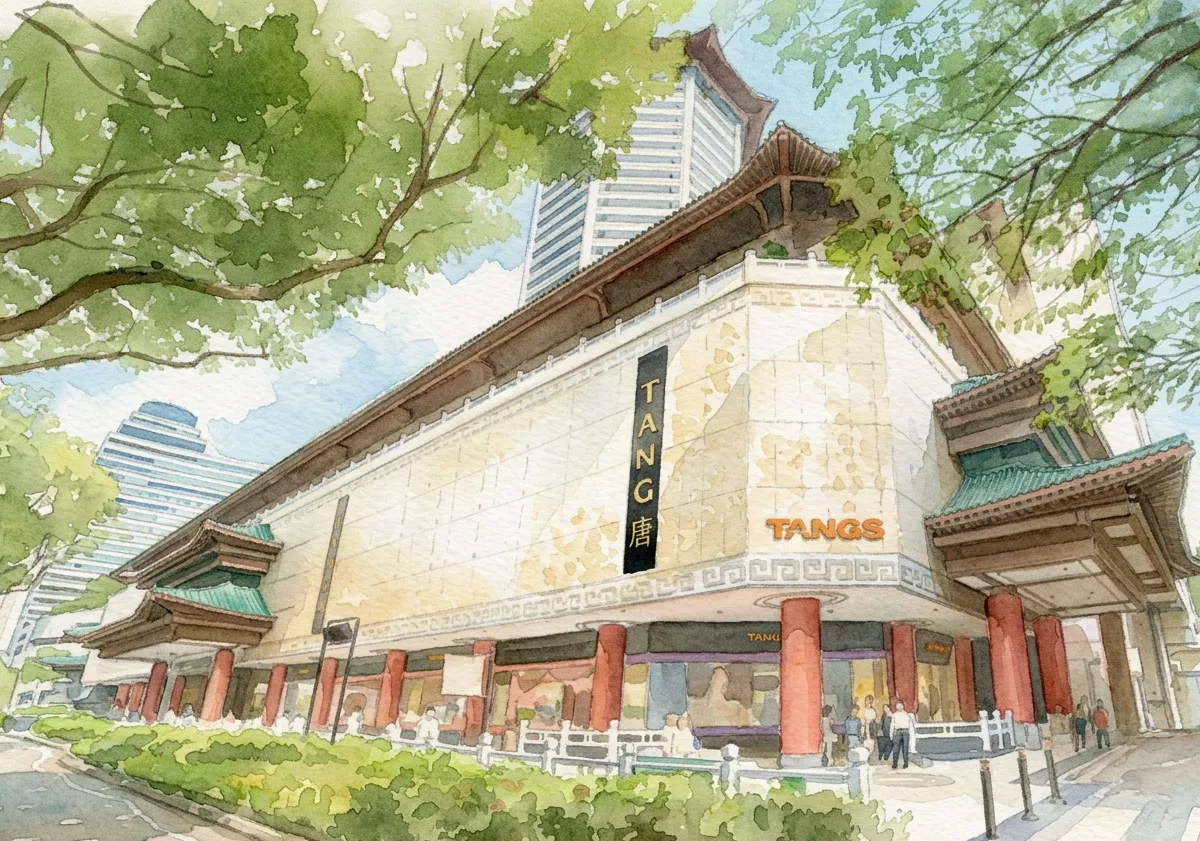
Every Singaporean who's walked down Orchard Road has passed it. The green pagoda roof. The red columns. That store that looks like someone lifted a corner of the Forbidden City and dropped it on our shiniest shopping street.
TANGS. I always assumed it was there because Orchard Road was Orchard Road.
Here's what I didn't know until recently. It was the other way around.
In 1923, a Teochew pastor's son named Tang Choon Keng stepped off a boat into colonial Singapore with nothing to sell but lace. He loaded Swatow embroidery into a pair of tin trunks, rented a rickshaw, and went door to door to the British housewives in the Tanglin bungalows. They called him the Tin Trunk Man. He didn't wait for customers. He went to them.
In 1932 he opened a shop with S$3,000. And for a while, that was the story.
Then came 1958. And the part that makes no sense on paper.
He bought a corner at Orchard and Scotts Road. S$10,000 for the plot. Cheap because it sat across from a Teochew cemetery, and no businessman in his right mind builds a shop facing the dead. Too far from town. His peers thought he'd lost it.
But Tang wasn't looking at the cemetery. He was looking at the road.
Those same expat housewives from Tanglin? They drove past this corner on their way into the city. Everyone was passing through. Nobody was stopping.
He didn't buy the land. He bought the people who drove past it.
So he built something they couldn't drive past. Green glazed tiles. Red doors. Teochew craftsmen carving the eaves by hand. A palace on a graveyard corner. He planted himself on their route, the way he'd once carried his trunks to their doors.
The shopping district didn't come to him. He made it come to him.
Land on that stretch went for about S$3 a square metre. It climbed to S$6,000. Two thousand times over. He didn't find Orchard Road. He seeded it.
But here's the part nobody talks about.
For 64 years, that store closed on Sundays. Every Sunday. The busiest shopping day of the week, doors shut, so his family and his Christian staff could go to church. He built the most valuable retail corner in Singapore and then walked away from one-seventh of its sales, every week, for six decades. Not because it made business sense. Because some things sat above it.
The man who read a road better than anyone alive refused to read it on a Sunday.
What's a place you drive past every day without ever really seeing what it could become?
This is the LinkedIn edit — written to fit inside 3,000 characters.