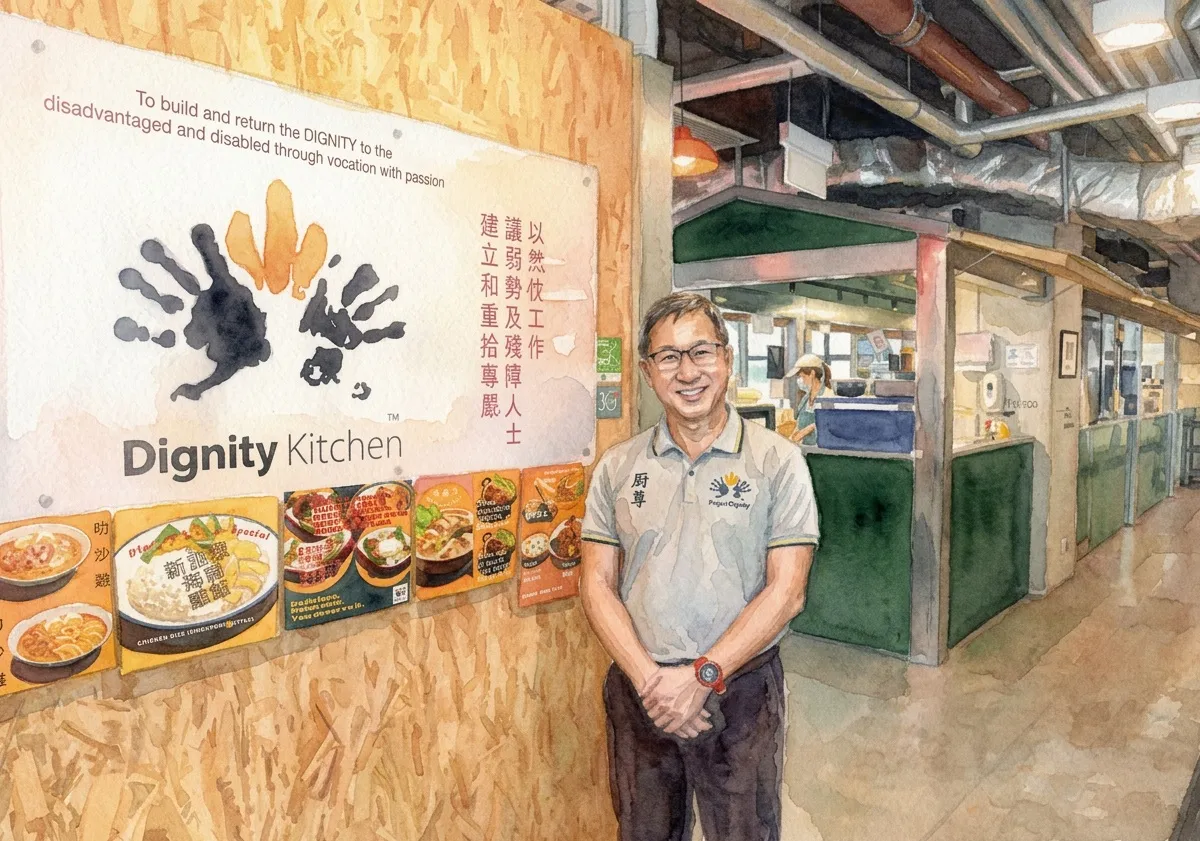
Koh Seng Choon / Dignity Kitchen
His first move was to label every worker's disability. First month revenue: S$97.
There's a food court in Singapore I keep coming back to in my head. Not because of the food. Because of the badges.
Koh Seng Choon spent 12 years in Sheffield as a management consultant. Came back to Singapore, worked at PwC, built his own consultancy helping companies expand into China and India. Classic corporate career.
His family had a philosophy: from 0 to 25 you learn, from 25 to 50 you earn, from 50 onward you give back.
So at 50, he walked away from all of it.
He'd met Tony, a polio survivor with one functional hand, who dreamed of being a chef. That meeting became the seed for Dignity Kitchen, Singapore's first food court staffed by disabled and disadvantaged workers.
Here's where the consultant brain kicked in.
His first move was to make every staff member wear a badge identifying their disability. "Deaf." "Blind." "Simple."
The logic was textbook consulting: set expectations, manage the customer, communicate clearly. Help people understand what they're dealing with.
First month revenue: S$97.
A customer walked up to him and said: "You must be mental to let people with mental disabilities cook your food."
He threw the badges away.
But here's the thing that stays with me.
He didn't just remove the labels. He reversed the entire model.
Most social enterprises try to teach disabled people to fit into the world. Koh flipped it. "Don't teach people with disabilities. Teach the world. If everybody learns just a little bit of sign language, it will help the deaf person to make coffee."
That's not an accommodation strategy. That's a completely different question.
The first three years were brutal. S$800 in losses every single day. He burned through S$700,000. Remortgaged his office for S$200,000. Worked five jobs simultaneously while his two kids studied abroad.
"Almost every day I wanted to quit. But I couldn't. There were people who depended on me."
Dignity Kitchen has been profitable since 2015. As of 2022, they've trained 2,900 disabled and disadvantaged people, placed 2,500 in employment. Tony, the polio survivor who started it all, retired having fulfilled his dream of being a chef.
The consultant who labelled every disability learned the hardest lesson of his career from a S$97 month: the problem was never his workers.
It was everyone else's assumptions.
What's something you had to completely unlearn before you could get it right?
This is the LinkedIn edit — written to fit inside 3,000 characters.