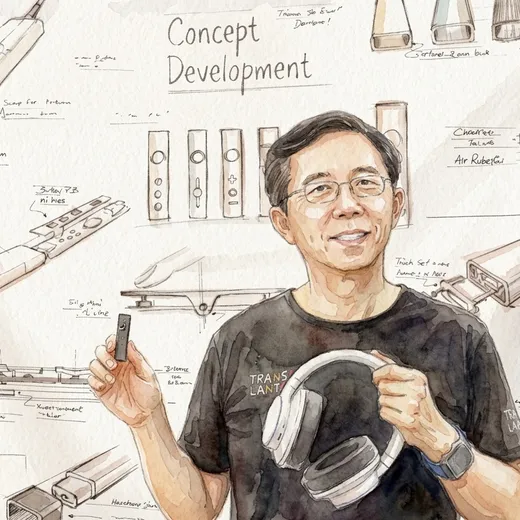
Hyperliquid / Jeff Yan

Most companies hire to compensate for a product that isn't good enough
There's a team of 11 people in Singapore that generated $76 million in revenue per person last year.
$843 million total. Zero outside investors. Eleven people.
Here's what I didn't know until I looked into this:
The founder, Jeff Yan, was raised by a single mom in California. Dad left when he was in third grade. No tutors. No prep programs. Taught himself physics from Feynman lectures.
By 18, he'd won gold at the International Physics Olympiad. Harvard. Math and CS. Ranked first in data structures as a freshman — in a class full of juniors.
Got hired at Hudson River Trading, one of the most elite quant firms on the planet.
Left after 8 months.
"What value have you added to the world?"
Moved to Puerto Rico with $10,000. Started a crypto trading firm from his apartment. Used a TV as his monitor. His first blockchain project got 100 users before dying.
But the trading firm? Grew into one of the largest anonymous operations in crypto.
Then FTX collapsed. And while everyone saw catastrophe, Yan saw a gap.
Traders were fleeing centralized exchanges. But every decentralized alternative was too slow, too clunky, too expensive. So he built his own blockchain from scratch. Purpose-built for trading.
But here's where it gets counterintuitive.
VCs came calling. $100 million at a $1 billion valuation. He said no. They kept coming back with bigger numbers. He kept saying no.
"If Bitcoin had taken a VC round, I really don't think it would be Bitcoin."
No marketing team. No sales team. No BD. Just 11 engineers, many from the same Olympiad circuits as Yan himself.
Instead of giving 20% of tokens to VCs like every other crypto project, he gave 31% directly to 94,000 users. Worth $16 billion at peak. The token went up after. That never happens.
2025: $2.9 trillion in trading volume. More monthly volume than Robinhood.
Eleven people eating family lunch in a quiet Singapore office.
Here's what stays with me:
Every company on LinkedIn announces headcount like a scoreboard. "We're 500 and growing!" "Just hit 1,000!"
Yan went the other direction. No investors. No marketing. No sales. Just product.
Most companies hire to compensate for a product that isn't good enough.
The best ones build something so good they never need to.
What's the smallest team you've seen do something that shouldn't have been possible?
This is the LinkedIn edit — written to fit inside 3,000 characters. Newer stories are written in full first, and the newsletter gets the whole thing.