The Family That Brought the Wet Market Indoors
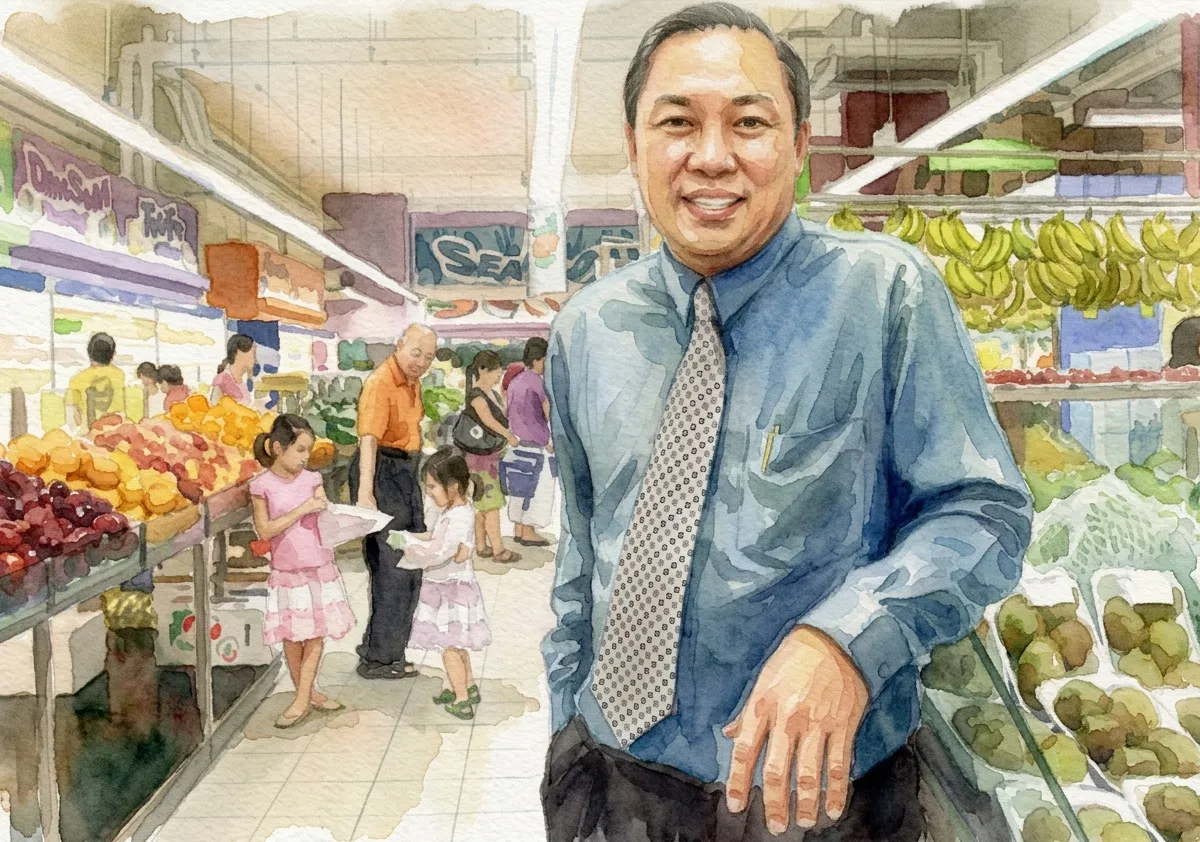
I've never met a Singaporean who couldn't tell you where their nearest Sheng Siong is.
90 stores. One of the two or three biggest grocers in the country. Worth billions.
Here's what I didn't know until recently: the man who built it used to clean pigsties.
Lim Hock Chee grew up on his father's pig farm in Punggol.
"Every day after school, I had to clean the pigsties and prepare the pigs' feed."
That was the job. Before homework. Every day.
Then in March 1984, Deputy Prime Minister Goh Keng Swee stood up in Parliament. Pig farming in Singapore would be phased out. Not restricted. Phased out. The reason given was the burden of it. Environmental. Economic.
There were at least 520 pig farms on the island in 1985. The plan was to cut that to 22 by 1990. Punggol's last farms held on to the end of the decade. So the family business had an expiry date.
What followed was a glut of pork. More of it on the market than the market could take.
Now think about what a sensible person does here.
You get out of pork. You find a trade with a future. You never smell a pigsty again.
The Lims went the other way.
In 1984 Lim Hock Chee and his wife rented a pork counter inside a Savewell supermarket in Ang Mo Kio. Rent was 20% of sales. Same pork. One step further down the chain.
Then Savewell itself ran into trouble and put its stores up for sale.
Lim Hock Chee and his two brothers borrowed from their father. They bought the Ang Mo Kio store in 1985 and named it Sheng Siong. Five employees. No frills. Thin margins.
But the move that actually explains the company came almost a decade later.
1995, Woodlands. Their third store. They built a wet market section into it — the first of their own stores to have one.
There were 168 supermarkets in Singapore by 1993. Cold Storage had spread across the island through the eighties and into the nineties. Self-service aisles. Imported goods. Premium lines. The National Heritage Board says supermarkets gave the wet markets stiff competition.
Sheng Siong walked the wet market back inside.
No source I found says why. But this was a family who had raised the pig before they ever sold the pork.
Here's what stays with me.
Twice, the trade this family knew was the thing to get away from. Twice, they moved toward it.
When your industry gets abolished, the instinct is to run for a cleaner one. But the knowledge doesn't die with the policy. It just has to move — one step closer to the customer.
They didn't stop knowing pork. They stopped being paid to raise it.
What do you know so well that you've stopped noticing it's worth something?
This is the LinkedIn edit — written to fit inside 3,000 characters.