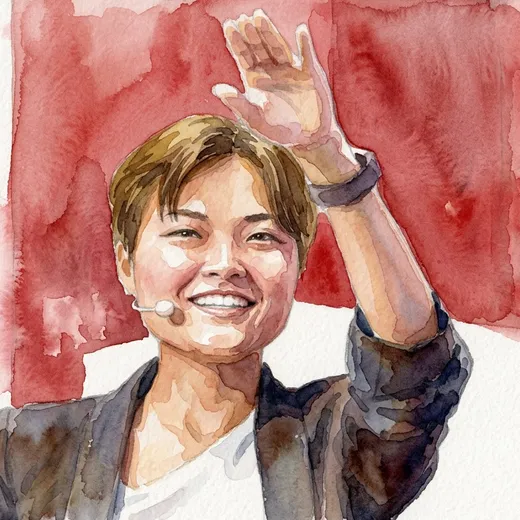
NousQ / CLiKX

The answer to a complex surgical problem wasn't a bigger machine. It was a smaller one.
In 2009, a Singapore surgeon flew to rural Cambodia on a humanitarian mission.
Hundreds of children had trekked across mountains to reach her. Many were going deaf from glue ear — fluid trapped behind the eardrum. The fix is straightforward: a tiny tube inserted into the eardrum to drain the fluid.
But Dr. Lynne Lim couldn't help them.
No operating theatre. No surgical microscope. No general anaesthesia. Without those three things, the surgery can't happen. She had to turn them away.
A surgeon standing in front of hundreds of children she knows how to help. The knowledge exists. The tubes exist. But the infrastructure doesn't. So the kids go home deaf.
120 million people globally need this surgery every year. Only 18 million get it. The bottleneck isn't medical knowledge. It's equipment.
But here's where the story takes a turn nobody would expect.
Some time later, Dr. Lim watched her daughter Natania get her ears pierced at a mall. The piercing gun clicked. Quick puncture, stud in place. One second.
And something clicked in her head too.
What if ear tube surgery could work the same way? A handheld device. One click. Tube in. No operating room needed.
An ear-piercing gun at a shopping mall. Inspiring a surgical robot.
She partnered with an NUS engineering professor and spent ten years building it. Five major redesigns. Twenty minor iterations. She called this period "the sickening valley of death" — years of development with funding that kept almost running out.
In 2021, during COVID, she co-founded NousQ to commercialize the device. Zero salary. Her co-founder Gan Chee Wee worked for minimal pay. A Harvard-trained surgeon betting everything on a device inspired by a mall piercing gun.
They called it CLiKX.
One handheld device. A proximity sensor shows the distance to the eardrum. Software programs the incision angle. Press a blue button. In one second, it makes the incision and inserts the tube. Replaces seven instruments and an entire operating room.
Patients in trials: "No pain, just a soft whirling sound, light pressure, then a click." Immediate hearing improvement. Home within an hour.
MedTech Innovator APAC Grand Prize. Cartier Women's Initiative first place. $7.5 million funding round oversubscribed. FDA trials underway.
Here's the thing:
For decades, the medical world tried to solve the access problem by building more operating rooms, training more anesthetists, funding more hospitals. Bigger solutions for a big problem.
Dr. Lim did the opposite. She made the solution so small it fits in one hand.
The answer to a complex surgical problem wasn't a bigger machine. It was a smaller one.
Sometimes the breakthrough isn't adding more. It's removing everything that's in the way.
What's a problem in your industry that everyone's solving by adding complexity — when the real answer might be to strip it down?
This is the LinkedIn edit — written to fit inside 3,000 characters. Newer stories are written in full first, and the newsletter gets the whole thing.