Sky Greens
50 years of agricultural scientists couldn't commercialize vertical farming. An aluminium factory owner did it in 4.
Singapore imports over 90% of its food.
Almost everything on your plate at the hawker centre came from somewhere else. If supply chains break, Singapore doesn't eat.
So here's a question that sounds ridiculous: How did Singapore end up exporting farming technology to Thailand, China, Vietnam, and Canada?
The answer starts in the backyard of an aluminium factory.
Jack Ng spent 30 years building facades, glass curtain walls, and cladding systems. Engineering, not agriculture. Aluminium, not soil.
Then the 2008 financial crisis hit, food prices spiked, and Jack started thinking about a problem he had zero business thinking about.
"Money is worthless without food. That's why I wanted to use my engineering skills to help Singapore farmers produce more food."
Most people would've donated to a food bank. Jack started prototyping in his factory backyard.
Here's what he built.
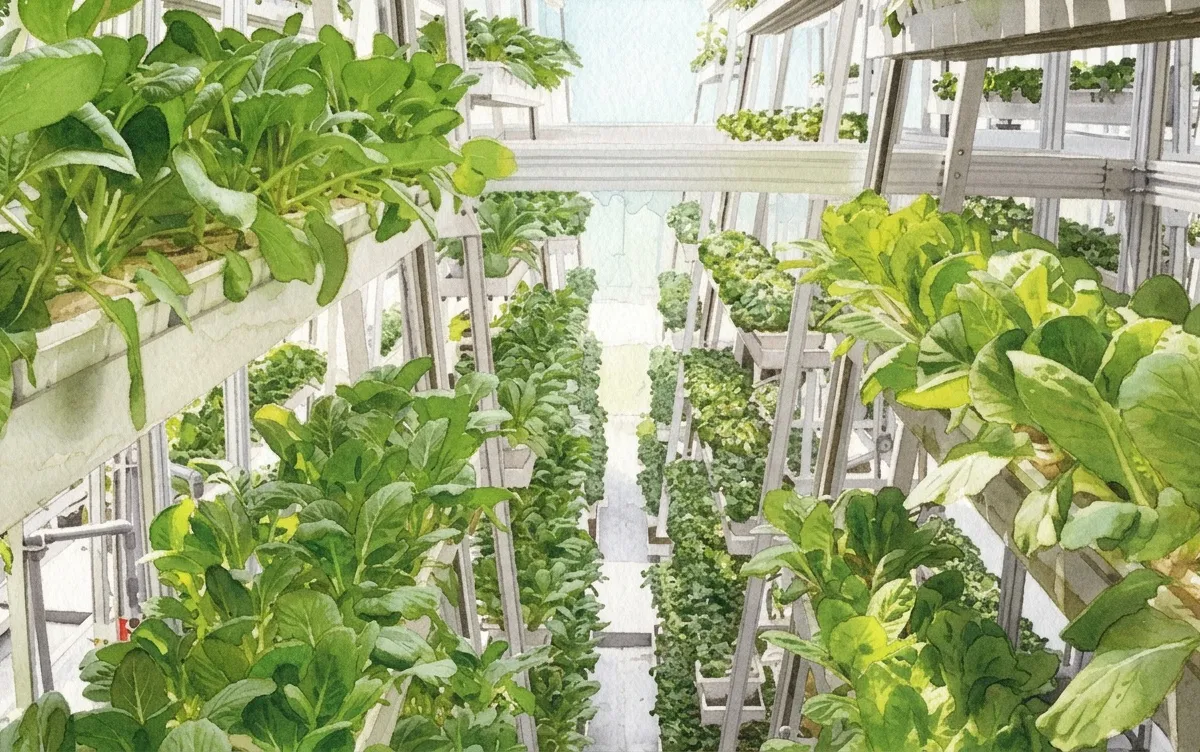
A 9-metre aluminium A-frame. Thirty-eight troughs of vegetables stacked vertically, rotating around the frame like a Ferris wheel. Sunlight at the top, water at the bottom, one full cycle every eight hours.
The power source? Not electricity. Not solar panels.
Gravity and water.
He designed a hydraulic system where 0.5 litres of water — half a bottle — generates enough force to rotate a 1.7-ton structure. The same water irrigates and fertilises the plants. The whole thing runs on S$3 of electricity per month.
Bicycle-chain mechanics and water pulleys. That's the technology an aluminium factory owner used to solve a problem agricultural scientists had theorised about for 50 years.
Vertical farming as a concept existed since the 1950s. Universities wrote papers. Futurists gave TED talks. Nobody commercialised it.
Jack did it in 4 years. Backyard prototype in 2009. Commercial harvest in 2012. S$1 million of his own money. No venture capital.
Each tower sits on 60 square feet — the size of a bathroom. Produces 10 times the yield of traditional farming. By 2015, 800 towers supplying major supermarkets. His A-Go-Gro system won the INDEX Award in Denmark — the world's biggest design prize — beating 1,123 entries from 72 countries.
Then he franchised it. Thailand. China. Vietnam. A company in Alberta, Canada now grows 30,000 strawberries year-round using Jack's system.
A country that can't grow food invented a new way to farm. And now teaches countries with actual farmland how to do it.
Here's the thing:
Everyone assumed vertical farming needed to be high-tech. Smart sensors, AI environments, millions in VC funding.
Jack used aluminium, gravity, and water. He didn't learn farming and add engineering. He used engineering and skipped the farming playbook entirely.
50 years of agricultural scientists couldn't crack it. An aluminium factory owner did it in 4 — because he never learned it was supposed to be complicated.
What's a problem in your field that an outsider might solve faster — simply because they don't know the "right" way to do it?
This is the LinkedIn edit — written to fit inside 3,000 characters. Newer stories are written in full first, and the newsletter gets the whole thing.