The School That Had To Fetch Its Own Pupils
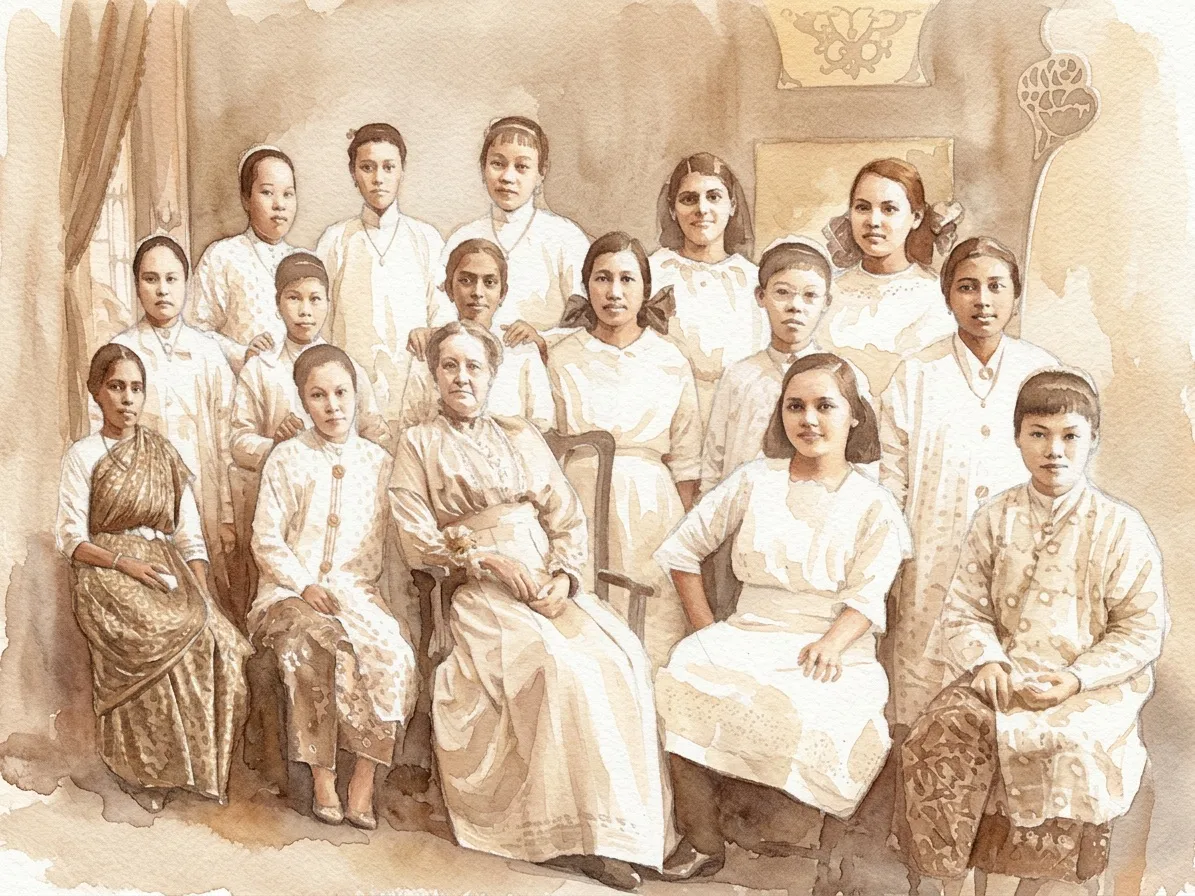
She didn't open a school and wait for pupils. She built the demand for girls' education before she built the school — then had to keep rebuilding it, by hand, for forty years.
I grew up assuming Singapore's oldest schools got built because parents wanted them.
Methodist Girls' School opened in 1887, and hardly anyone wanted it.
Back then it was the Tamil Girls' School.
Sophia Blackmore, an Australian missionary, opened it anyway. Thirty years later she wrote:
"...there was but little demand in those days for female education. To create this demand has been part of our task."
Singapore's National Library says her own Australian church wouldn't back an unmarried woman missionary. An American board sent her.
She landed in Singapore in mid-July 1887. She wrote her board a plan. "My intention is at present, to visit from house to house, teaching and getting in as much evangelistic work as I can."
There was no school yet.
The school's own history says it opened the next month with nine Tamil girls, in a rented shophouse. Their fathers gave the money and the furniture, the history says.
Her year-one report has a different problem. It names one of her assistants. "But the attendance this year has not been satisfactory... it is only by constant visiting that Miss Hagedorn is able to keep up the numbers at all."
The classroom kept emptying. Miss Hagedorn went out to the houses, constantly, and kept refilling it.
By 1892 she had a second school in Telok Ayer. Its teacher was Nora Wheatley. Wheatley fetched nearly all of her twenty pupils by closed carriage. The 1890 report budgets Blackmore's salary at $650. Carriage hire: $230.
Blackmore went "entirely to heathen houses," her words.
One family knew exactly what the school was for. An uncle told one of the pupils: "...they will soon be making a Christian of you." The girl said that was just what she wanted to be. He told her they wouldn't have her in the house.
The numbers went up anyway.
Forty-two pupils by 1890. Sixty-five by 1892. "We have changed the name to Methodist Girls' School," Blackmore wrote.
Her Tamil teacher that year was D. Suppamma. Suppamma was one of the girls who came to school the day it opened.
Blackmore's 1892 report: "I am asking for two ladies... I ought to get away immediately, before I break down completely."
Her board budgets her passage home. She went. She came back.
She left Singapore in January 1928, after forty years.
Here's what stays with me:
She never got to build the demand once and bank it.
Parents moved away. One mother became afraid as she saw her three girls refuse to prepare for their idol feasts. Their lessons stopped. The numbers had to be built back up by hand, house by house.
Most founders treat demand as something you go and find. She treated it as something you manufacture, and then as inventory that spoils.
In 1992 the school moved to a campus on Blackmore Drive.
What part of your demand would quietly empty out this month if nobody went and rebuilt it?
This is the LinkedIn edit — written to fit inside 3,000 characters.